Wednesday, January 25, 2006

Facts on Fakes

We believe one of the problems in tackling fakes, is the lack of data about them. Partly this reflects companies' reluctance to disclose the size of their problem, but perhaps more importantly it is because there's so little feedback from the marketplace to the brand owners.


We can infer the size of the problem (it's big), from culling some recent news items:

  • Louis Vuitton - a much copied brand and a division of luxury brand owner LVMH - says its network of 250 agents, investigators and lawyers engaged in the anti-counterfeiting struggle conducted 6,000 raids worldwide in 2004, resulting in 1,000 arrests.
  • In any one day, the Scotch Whisky Association (SWA) are prosecuting 50 cases [of Scotch whisky counterfeiting] around the world with people trying to pass products off as Scotch whisky. For example, the SWA estimates that there are 22-30 million cases of counterfeit Scotch sloshing around the Indian whisky market. It is not unknown for producers of allegedly genuine Scotch whisky to give substantial discounts if the bottles and screw tops were returned after use (a simple ploy to circumvent many anti-counterfeit devices on legitimate packaging).
  • Counterfeit drugs continues to be the most newsworthy. The Food and Drug Administration investigated 58 cases of drug counterfeiting in 2004, up from four cases in 1998, according to an agency report. Last year, about 1.7 million tablets of fake Viagra, one million tablets of Lipitor, and half a million tablets of Norvasc were seized in China.

In other words - millions of people every year are (often unknowingly) buying fake Scotch, fake Viagra, fake Lipitor, and fake Norvasc.

Monday, January 23, 2006

Fake Tamiflu Starts Its Own Epidemic
The trickle of fake flu drugs I blogged about here a few weeks ago has become a river ... or at least the news of it has. A couple of days ago, the FDA released a Statement, which included these sobering observations:

it is often impossible for unsuspecting consumers to differentiate between these products and those that are not genuine

and
advertised products may be counterfeit versions of genuine products, or impure, contaminated, sub potent or super potent products.

The FDA continues to champion adoption of RFID for supply chain security - but this is of modest help to the consumer. Currently, one of the only resources to consumers is SafeMedicines.org which provides news alerts on instances of counterfeits, and advice on buying pharmaceuticals over the Internet.

Wednesday, January 11, 2006

Technology Fakes

Much of the counterfeit news is dominated by fake drugs. However, PC World recently investigated the prevalence of fake consumer electronics. In keeping with our efforts to report on actual data, PC World found the following:
  • Alaska: 20,000 suspected fake Memorex USB memory key thumb drives from Asia
  • Miami: 900 allegedly phony laptops
  • Three of the top ten items that US Customs agents seized in 2004 were consumer electronics, batteries, and computer hardware
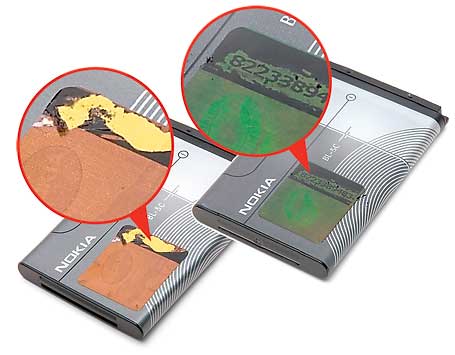
  • PC World purchased seven hard drives, seven memory modules, and ten cell phone batteries online, using pricing search engines to find low prices. We then asked vendors to authenticate the gear. Of the two dozen products we bought, four (all cell phone batteries) were counterfeit - Nokia, Motorola, and Kyocera. 40% of the cell phone batteries purchased online in the US turned out to be fake!
At least Nokia had provided a method for consumers to check authenticity. They included a hologram and unique serial number under a scratch off panel. The counterfeiters spoofed the hologram but didn't bother with the code - images here.

PC World hit on the major problem facing consumers:
Regardless of where a fake comes from, you probably won't know it's bogus until you try to get the nominal maker to service it.
Nokia is unusual in providing its customers a way to check the authenticity of their products. This powerful tool is what YottaMark provides brand owners.

Tuesday, January 10, 2006

UK TV Program Exposes Problem of Fake Drugs

An investigative report by the UK's ITV which ran on 9th Jan used investigative reporting techniques to expose just how easy it is to infiltrate fake drugs into the UK's retail and hospital supply chain.

IS YOUR MEDICINE FAKE? A TONIGHT SPECIAL: Fiona Foster presents a report on the illegal market for counterfeit drugs. She investigates how potentially dangerous forms of medicine can enter the supply chain for the NHS - and even be sold in high-street pharmacies. (ITV1, 8pm)

In July 2005, the UK's BBC had run a similar program on Fake Drugs. Both referred to the discovery of a fake Viagra plant running in a warehouse in a London suburb.

What made the ITV program unusual was the successful, and purposefully deceitful, application for a wholesale drug license from the MHRA using fake identities and a rented office space. The MHRA immediately responded with a press release, indicating that it was within its rights to investigate the ITV programmers for making a false application. The program probably villified the MHRA unfairly, and the 'made-for-television' sting with hidden-cameras and disguised faces smacked of grandstanding. However, the problem is real - and the program demonstrated to a comfortably-numb TV audience how pervasive it could be.

Especially telling, was the number of times middle-men and patients said they looked at the packaging - even had it 'inspected' - and figured it was authentic. Only when one patient went online to find out which lot numbers of Lipitor had been counterfeit, did she go to her doctor. A better system which allows users to differentiate between real and fake by looking at the packaging is required - one which can be more proactive and informative than holograms or security inks.


Monday, January 09, 2006

More Fake Tamiflu Arrives ... But How Can Consumers Tell?
Another couple of shipments of fake Tamiflu have been intercepted coming into Chicago and New York. Without a doubt, this is only the tip of the iceberg that the US CBP have been able to catch. The problem, is: how can a consumer tell if they're getting the real thing or a fake? At $200 for 10 tablets online, and a panicked market - it's an target-rich environment for counterfeiters. There are some common-sense tips:
  • Make sure it has the right FDA label,
  • There is no such thing as "generic" Tamiflu,
  • Buy only from VIPPS online pharmacies,
  • Be suspicious if the text is in a foreign language (it could be a diverted product, if not a fake).
  • It should look like this.
In the long run, however, a more reliable and consumer-friendly method is needed for allowing patients to authenticate the products they buy.
This is a situation where YottaMark's solution is more effective, and easier for consumers than any of the above methods.
Viagra & Chips

Pfizer recently announced the start of its trial of RFID tagging bottles of Viagra in the US, to prevent counterfeiting. It is worth noting that the tags are for pharmacists to check (although very few pharmacies have RFID equipment yet) and the pills would be re-packed into amber vials for consumers - to avoid privacy concerns.

The RFID tag will contain the EPC, which can be checked against a database of issued EPCs. This can help prevent fraud and diversion. Importantly, however, RFID tags are not themselves counterfeit-proof, and can be copied - so Pfizer is probably using a one-time use database, that can only be accessed by authorized users. Pfizer will be including a 2D datamatrix in the event that the RFID tag fails (how many pharmacies have 2D datamatrix readers?).

"Viagra was selected for the RFID project because it has been a major target for counterfeiters,"
Pfizer said in a statement.

The company plans to spend about $5 million on the project for RFID labels.


Thursday, January 05, 2006

No Surprise: Counterfeiting Damages Brand Value
A newly released survey confirms what we may intuitively have known all along: counterfeiting damages brand value - particularly in the eyes of the most valuable consumers. What perhaps is more interesting, is that 25% of these luxury goods buyers have difficulty spotting a fake, and they think the problem will be getting worse.

Tuesday, January 03, 2006

Engaging Consumers in the Fight
It's a courageous way to tackle counterfeits ... empower the consumer. We're beginning to see more public acknowledgment of the problem (for example recent Glaxo ads in press, Nokia's user-authenticable cell phone battery), and now the Italian government has launched a counterfeit 'whistle-blower' hot-line - for customers or retailers to call in suspected fakes.

This actually makes a lot of sense. Consumers care about brand integrity and safety for many products - and want to be able to either check the authenticity of a product, or offer a sort of 'neighborhood watch' on the marketplace. Vendors such as HP, Kingston, and Motorola say they usually learn about counterfeiting problems as a result of consumer complaints.
Counterfeits flourish in dark corners - a bright light on the problem - and greater consumer awareness - will benefit legitimate manufacturers in the long run. In China, ironically, the QBPC is very active in educating consumers about fakes. In the US, on the other hand, the "No Trade in Fakes", STOP initiative, and other such programs sponsored by industry groups are aimed more at legal recourse and manufacturer education of IPR, than consumer empowerment.

Monday, December 19, 2005

The Scourge of Fake Drugs on Fighting Malaria
Continuing our search for fact-based analysis, we compiled this data on the challenges facing global health organizations battling malaria. Worldwide, 645 million people are at risk from malaria. Prompt access to treatment with effective, safe medicines, such as artemisinin-based combination therapies (ACTs) and insecticide treated nets, saves lives:
  • A recent study in The Lancet concluded that up to 40% of artusenate products (the most effective drug against malaria) contain no active ingredients.
  • A study conducted in South-East Asia in 2001 revealed that 38% of 104 antimalarial drugs on sale in pharmacies did not contain any active ingredients. There were forged holograms on fake artesunate blisterpacks bought in Vietnam and Cambodia.
  • The WHO reported that in 1999, at least 30 people died in Cambodia after taking counterfeit antimalarials
  • According to the "Roll Back Malaria Partnership", counterfeit insecticide treated nets are now proliferating, due to the difficulty of obtaining the real thing.

What is lacking is an effective solution, appropriate for these countries, and the level of education available to NGOs and consumers.

Sunday, December 18, 2005

Fake Flu Drugs
It was inevitable, given the fear about an avian flu pandemic and subsequent panic buying, that counterfeit Tamiflu has been found in the US by US Customs. Apparently, 1000 Exxon-Mobil employees were recently given fake vaccines. Roche, the manufacturer of Tamiflu, recommends consumer use the color and taste of the drug, and packaging info to help identify authentic product.

‘Tamiflu is contained in a distinctive yellow and light grey capsule and the powder has a very bitter taste. Also the batch number, expiry date and manufacture dates need to match up on the outside packaging and the blister pack.

Wednesday, December 07, 2005

How Big a Problem?
There's an oft-repeated quote, attribtued to various sources, that counterfeits make up 7-8% of world trade. Rather than rely on a top-down, hard-to-validate number, we look for bottom-up, recent fact based evidence.
  • Michelin estimated that 50,000-70,000 countfeit tyres have been sold in Europe in the last 18 months at half the price of those made by Michelin. They plan to take action against any distributors found selling fakes as Michelins. It's not clear how they will police the 5,000 distributors or detect fakes.
  • Denso estimates it has losses of several million dollars a year from counterfeit spark plugs .
  • This data rich report reviewed worldwide counterfeit enforcement activity (investigations, raids, seizures, arrests, charges, convictions, sentences, civil litigation ) for October 2005. This data is new:
"... 18 million pirated items originating from China worth $13 Million were seized from 120 consignments in the 10 day period. If the operation was to continue year round, it would equate to 175 fully loaded Boeing 747 cargo aircraft entering the EU annually with goods valued at $500 Million. If customs organizations would release reports on individual seizures, the public would be more informed about the scope of the problem and dangers that items such as counterfeit drugs, sunglasses, mobile phone batteries and razorblades pose to the public."

Monday, December 05, 2005

Kicking Off YottaBlog

Welcome to the YottaMark blog. We'll post news and information about global counterfeiting and the technologies available to tackle it.